
Factory to order
From Block to Finished Form
Geoscenic Stone works factory-to-order: no shelf stock, no substitutions, every piece is cut, formed, finished and inspected against the production drawing you approved. This page shows the sequence honestly, photographed in the real production environments where the work happens.
Our production partners carry out the required cutting, forming, finishing and packing processes according to the approved product specification.
01
Enquiry & brief
You describe the piece, the dimensions your space needs, the stone direction and the destination.
02
Itemised quotation
Production, packing and delivery priced separately for your configuration and address.
03
Production drawing
Dimensions, tolerances, stone, finish, edge and drillings on one document you approve before anything is cut.
04
Material selection
A slab or block is chosen for colour and movement against your piece; veined material is photographed for your confirmation.
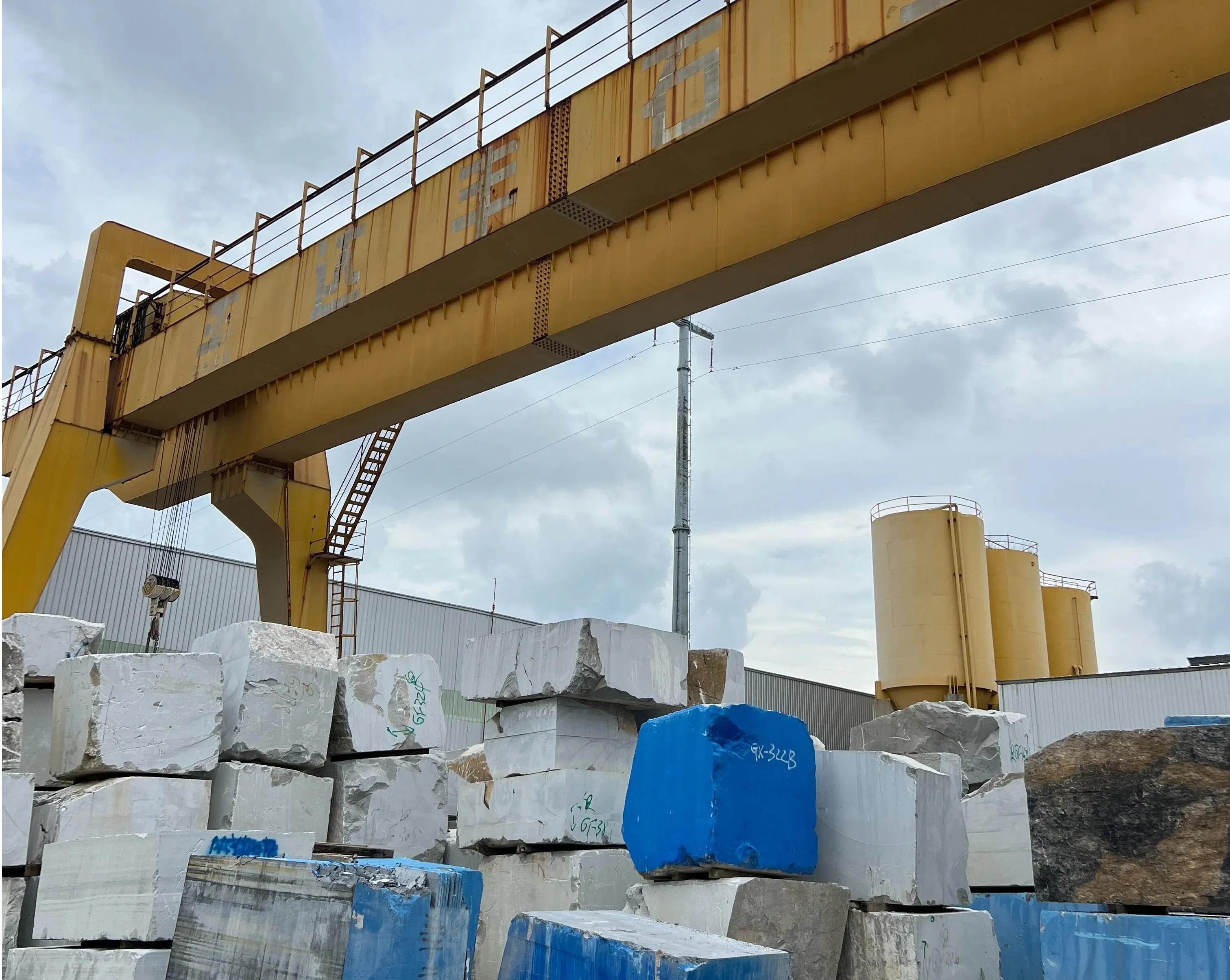
Stone slabs racked in a production hall, moved by overhead crane 05
Cutting
Bridge saws take the primary cuts with water suppression; shaped work is cut to the drawing.
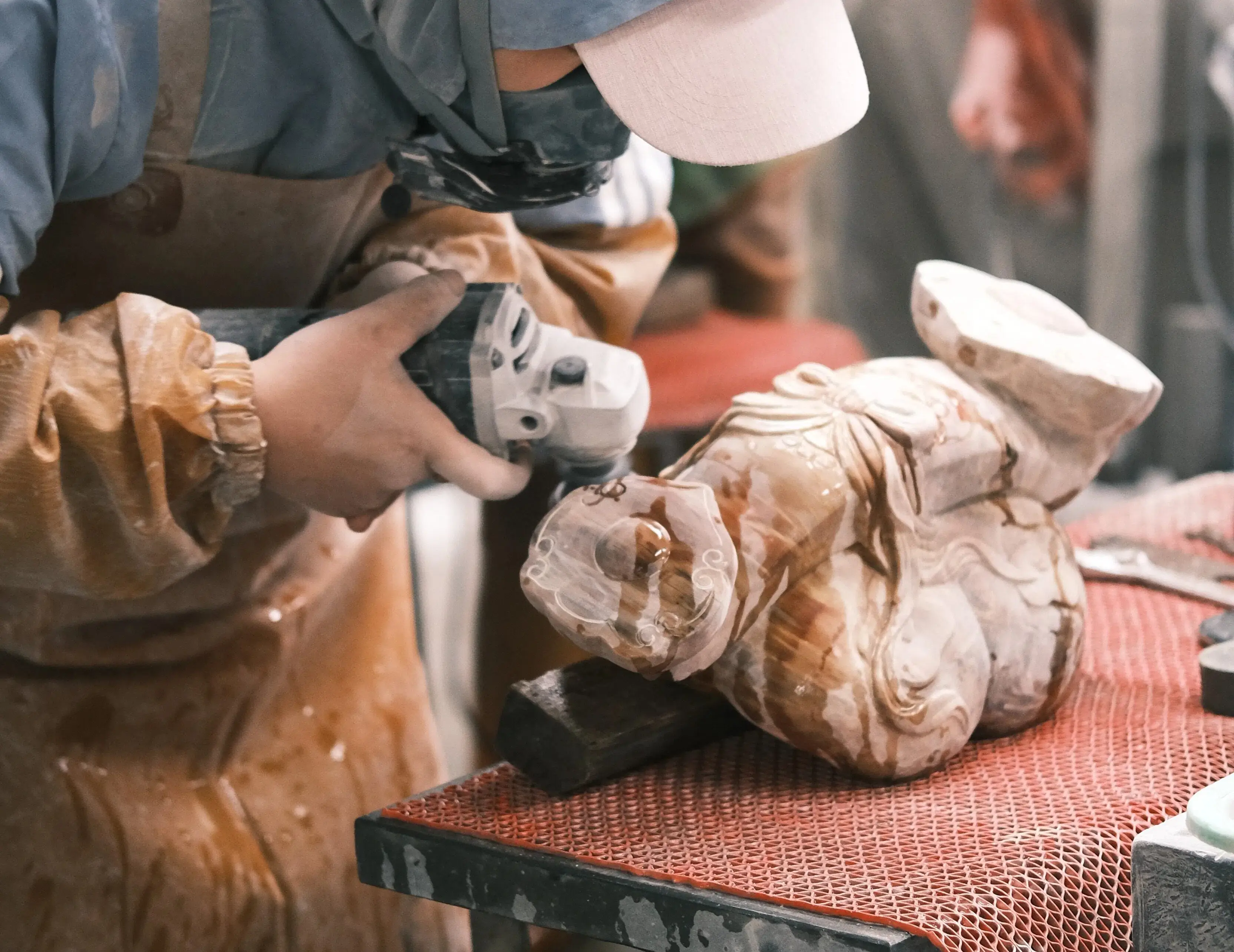
Bridge saw making a primary cut with water suppression 06
Forming & shaping
Curves, hollows and profiles are formed; basins are cored and drilled to the stated positions.
07
Finishing
Edges are profiled and surfaces honed or polished; hand work refines what machines rough out.
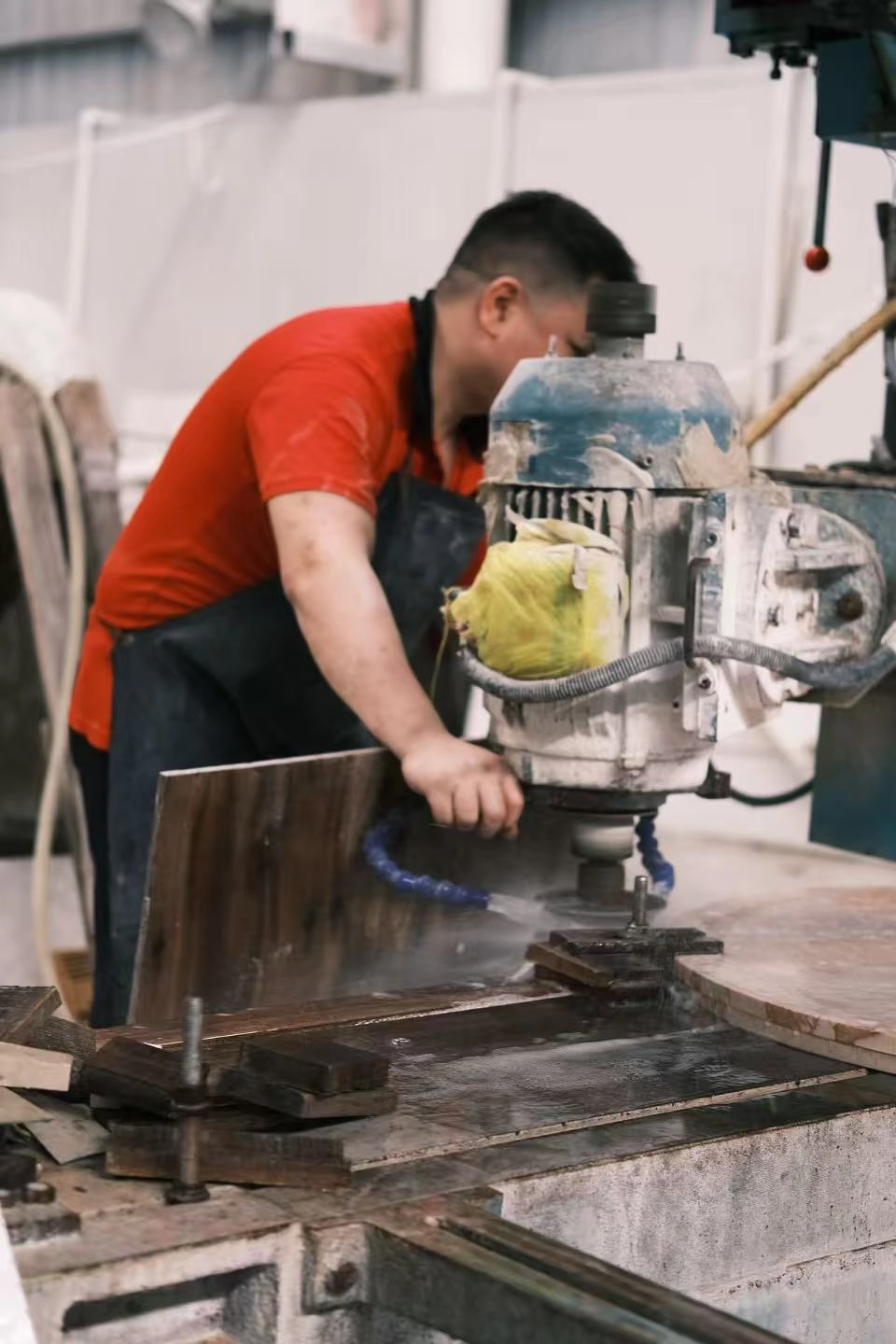
Automated edge-polishing of a circular stone top 08
Dry inspection
The piece is assembled as it will stand, measured against the drawing and inspected in raking light.
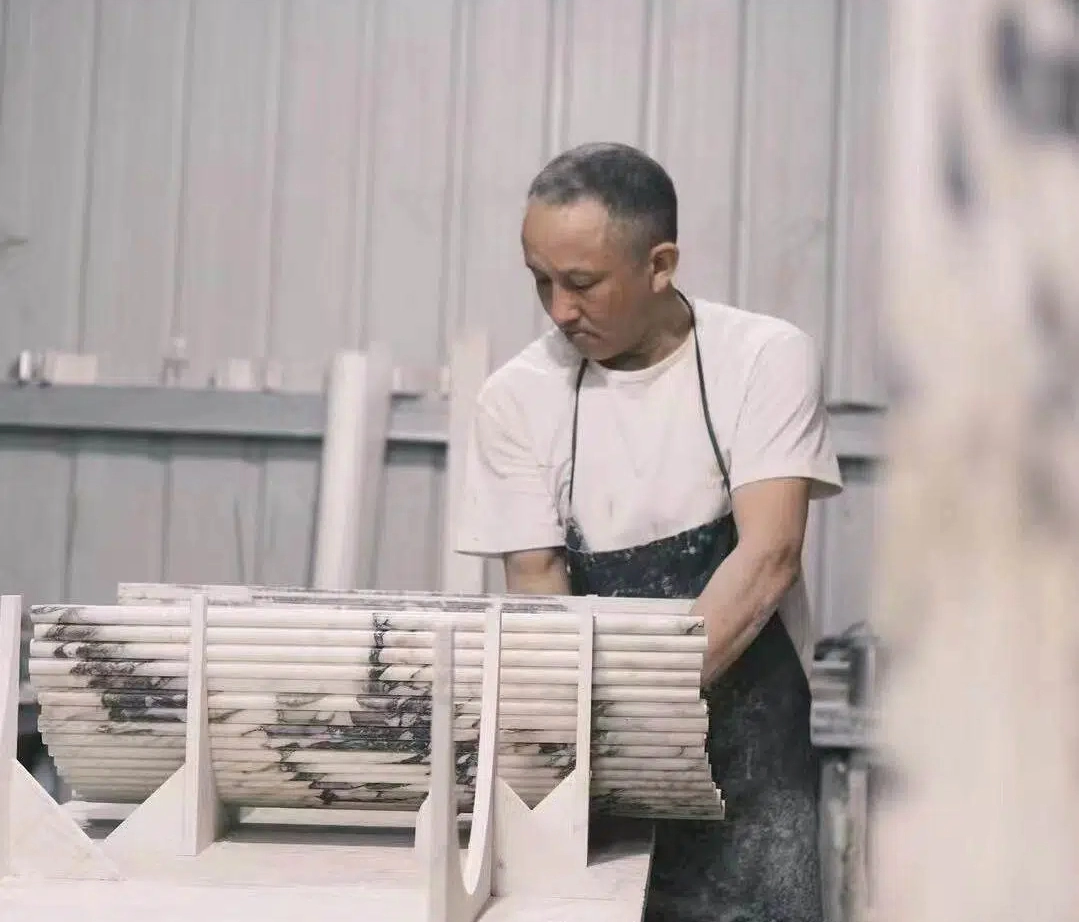
Finished stone surfaces awaiting inspection 09
Packing
Faces protected, edges padded, components braced in an individual timber export crate.
10
Delivery & placement
Freight to your destination at the service level you chose, kerbside, to the door, or placed in the room where available.
One document governs everything
The approved production drawing carries dimensions, tolerances, stone, finish, edge profile and drillings. The workshop cuts to it, inspection measures against it, and any mid-production question is resolved by updating it, never by unrecorded conversation. It is the reason a piece specified from anywhere in the world arrives as specified.
Discuss a Factory-to-Order Project
FAQ
Frequently Asked Questions
Does Geoscenic Stone own the factory?
We describe the arrangement precisely: Geoscenic Stone is headquartered in Singapore and works directly with a specialist stone manufacturing network, and we do not make ownership claims on this site that we have not published elsewhere in writing. What matters to your order is the working structure, which is direct: your production drawing goes to the workshop that cuts your piece, our specification governs the work, and quality review happens against that approved drawing before packing. The photographs on this page show real production environments in that network, slab handling, bridge-saw cutting, edge polishing and finished surfaces, captioned by what can actually be seen rather than by claims.
What happens between my approval and the finished piece?
A fixed sequence. Material is selected first, a slab or block chosen for colour and movement against your piece, confirmed with you where the veining matters. Cutting follows: bridge saws take the primary cuts, and shaped work is formed to the drawing. Then the slow part, finishing: edges are profiled, surfaces honed or polished, and hand work refines what machines rough out. The piece is then dry-checked, assembled or laid out as it will stand, measured against the drawing, surfaces inspected in raking light. Only after that does packing begin: protection on faces and edges, bracing, and an individual export crate. Each stage exists to catch problems while they are still cheap to fix.
How is quality controlled on a made-to-order piece?
Against the drawing, at every stage, because with no stock there is no “pick a better one” at the end. The approved production drawing states dimensions, tolerances, stone, finish and edge profile, and it is the reference the workshop cuts to and the standard the piece is inspected against. Dimensional checks happen after cutting and again at dry inspection; surfaces are reviewed for finish consistency, chips and cracks under directed light; drilled positions on basins are verified against the plumbing layout you supplied. Anything outside specification is reworked or recut before packing rather than shipped hopefully. If you want evidence rather than assurance, ask at quotation: pre-dispatch photographs of your specific piece can be arranged.
What machinery is used to make the pieces?
The photographs show the honest answer for the stages pictured: overhead cranes moving slabs in the production hall, a bridge saw making primary cuts with water suppression, and automated edge-polishing equipment finishing a circular top. Around those stages sits the usual grammar of stone work, coring and drilling for basin waste and tap positions, profile tooling for edges, and hand finishing where a form needs judgement rather than repetition, such as fluting and sculptural surfaces. We deliberately do not list machine brands, capacities or headcounts here, because we publish what we can show. What the equipment adds up to for you is simple: straight cuts that are actually straight, repeatable edges, and surfaces finished evenly at scale.
Can a piece be made from a drawing I supply?
Yes, supplied drawings are a normal starting point, especially from designers and architects. Send what you have: a dimensioned CAD file is ideal, but a hand sketch with measurements or even a reference photograph with target sizes is workable. We convert it into a production drawing in our format, which is where feasibility gets engineered, stone thickness for the spans involved, joint positions on multi-part pieces, weight and handling implications, and we return it with a quotation. You approve that drawing, not your original sketch, so nothing rests on interpretation. Where your design needs adjustment to be safely produced in stone, we propose the change explicitly rather than quietly building something different.
How do you handle very heavy pieces safely?
Weight is planned, not discovered. It starts at the drawing: solid stone is heavy enough that a dining top or bathtub is engineered with handling in mind, lifting points, base geometry that tolerates moving, and sensible component splits where a one-piece design would be unmanageable. In production, cranes and mechanical handling move slabs and blocks, as the production-hall photograph shows. For dispatch, crates are built to the piece’s weight with forklift access, and your quotation notes approximate crate weight so delivery access can be checked in advance. At your end, heavy pieces come with placement guidance, and where a floor-loading question exists, bathtubs especially, we raise it before production rather than after delivery.
Are offcuts and waste material reused?
Where it is genuinely practical, yes, smaller catalogue objects such as trays, soap dishes, candle holders and vase blocks are well suited to material that would not yield a large piece, and cutting plans are laid out to use slabs efficiently in the first place. We stop short of dressing that up as an environmental programme: we do not publish sustainability claims, certifications or recovery percentages we cannot substantiate, and stone working does produce genuine waste, water-cooled cutting slurry and fragments that have no second life. If responsible sourcing documentation matters to your project, ask at quotation and we will tell you exactly what can and cannot be evidenced for the stones you are considering.
Can I visit the factory or see my piece in production?
Production visits are handled case by case and must be arranged in advance through a consultation enquiry, manufacturing sites have safety and scheduling constraints, and we would rather say “arranged, on these dates” than imply an open door that does not exist. For most clients, the practical alternative works better: photographs or video of your specific piece at agreed stages, slab selection, after cutting, at dry inspection, sent for your review before packing. Trade clients running larger projects can discuss structured progress reporting as part of project terms. Note that our Singapore address is an office for consultations by appointment; it is not a factory, showroom or collection point.
What does “dry inspection” mean before packing?
It is the full rehearsal of your piece before it travels. Components are assembled or laid out exactly as they will stand in your room, top on base, basin on pedestal, then measured against the approved drawing and inspected surface by surface. Dimensions and squareness are checked with the components actually mated, because a top and base that each measure correctly can still meet badly; drilled positions are verified; finishes are examined in raking light, which shows waviness and scratches that flat light hides. Faults found here are corrected while correction is still possible. Only a piece that has passed dry inspection is signed off for packing, which is why unpacking at your end should hold no surprises.
How is the factory work specified so nothing is lost in translation?
Everything flows through one document: the production drawing. It carries dimensions and tolerances, stone selection, finish, edge profile, drilling positions and any assembly details, in drawing conventions that do not depend on language. You approve it, the workshop cuts to it, inspection measures against it, and if a question arises mid-production it is resolved by updating the drawing rather than by conversation that leaves no record. Photographs support the drawing where character matters, the selected slab for a veined top, for example. The discipline sounds bureaucratic and is the opposite: it is what lets a piece specified in Singapore or Paris be cut accurately by a workshop that never met you.