

Key Takeaways
Marble veining is both a geological record and a design tool. Its direction, scale and continuity can change how a finished surface is read.
- Mineral deposits create the colour and movement seen in marble veins.
- Cutting direction can turn similar stone into stripes, waves or swirls.
- Slab orientation should respond to the room, the object and the intended focal point.
- Bookmatching and careful seam planning help preserve visual continuity.
- Full-slab review and clear fabrication drawings reduce avoidable surprises.
What marble veining is and why it varies
Marble veining refers to the lines, bands and areas of mineral movement running through a natural stone slab. These marks are not printed onto the surface; they belong to the material itself and may change in colour, density and direction from one area to another. That variation is central to the character of marble, particularly when a piece is made to measure rather than selected from identical stock.

How mineral deposits create veins
Marble begins as limestone transformed by heat and pressure. During its geological formation, mineral-rich fluids can travel through fractures and spaces, leaving deposits that later appear as coloured lines or cloudy movement. The mineral mix and the pressure involved affect whether the result is a delicate grey thread, a warm blush or a broad, strongly contrasting band.
The difference between veining, grain and natural movement
Veining usually describes distinct lines or bands, while grain can suggest a finer directional texture within the stone. Natural movement is a wider design term that includes clouds, patches, waves and irregular tonal shifts as well as obvious veins. A slab may therefore look quiet at one end and animated at the other without either area being less authentic.
A useful natural stone variation guide shows why geological formation, mineral composition and cutting can produce different appearances even within the same broad stone category. The key is to assess the whole visual field rather than treating one small mark as the complete pattern.
Common marble veining patterns
Some marbles have fine, branching lines that create a restrained surface. Others have long, sweeping bands, feathery wisps, cloudy areas or dense intersecting marks. The contrast between background and vein matters as much as the line itself: pale grey on white reads quietly, while dark green or charcoal movement becomes a stronger architectural feature.
Why each slab has a unique appearance
Natural stone forms in changing conditions, so no two slabs develop precisely the same arrangement of minerals. Even slabs quarried from the same block can differ in tone, fissures and the position of their strongest movement. The full slab tells the story more reliably than a sample, which is why selection should happen with the intended dimensions and cut lines in mind.
How vein direction affects the visual design
Vein direction influences the way the eye travels across a surface. It can reinforce a long wall, soften a compact object or introduce tension against straight cabinetry and joinery. The most successful choice is rarely the most dramatic one in isolation; it is the direction that supports the proportions and purpose of the finished piece.

Horizontal, vertical and diagonal vein directions
Horizontal veins can make a worktop or wall feel longer and more continuous. Vertical movement can add height to a panel, fireplace or vanity front, while diagonal lines create energy and can lead the eye towards a focal point. The same slab may produce very different impressions when rotated, so orientation should be discussed before cutting rather than left to the installation stage.
Fine lines versus bold, sweeping movement
Fine veining tends to sit quietly within a room, allowing furniture, lighting or joinery to share attention. Bold movement is more assertive and may work best when surrounding forms are simple. On a large island or full-height panel, strong veins can become the main composition; on a smaller item, they may need careful placement so a single dark mark does not dominate.
How direction changes the sense of space
A long, lateral pattern can visually extend a narrow surface, while upright movement may make a low element feel taller. Diagonal movement can break up a rigid arrangement but may also make seams more noticeable if adjoining pieces are not planned together. Lighting changes this reading again, particularly when raking light catches differences in polish or relief.
Matching veining to a room’s architectural lines
Look at the lines already present in the room: cabinet rails, window reveals, stair flights, ceiling joints and door openings. Veining that echoes these directions often feels calm and deliberate. A contrasting orientation can be effective too, but it should be chosen as a clear design decision rather than created by an accidental rotation.
For a more unusual project, even a method built around making small, manageable openings can help organise a complex selection process; the “Swiss Cheese” method is one example of that broader planning idea. In practical terms, mark the key surfaces first, then test how the strongest veins would travel through them.
How cutting and slab orientation change the result
The saw direction determines which geological features become visible on the face of the stone. A block that appears relatively quiet from one direction may reveal long bands or circular movement when cut another way. This is why the phrase “the same marble” does not necessarily mean the same visual result.

Vein-cut and cross-cut marble explained
Vein-cutting follows a direction that commonly exposes longer, more linear bands. Cross-cutting changes the relationship between the saw and the geological layers, often revealing cloudier, wavier or more swirling movement. Neither approach is inherently better; each creates a different design language and should be judged against the intended application.
Choosing the best orientation for a worktop or wall
For a long island, linear movement may reinforce the run of the surface, while a cross-cut appearance can make the same island feel more organic. On a wall, the decision may depend on whether the stone should read as a calm field or a prominent picture-like feature. Confirm the orientation using slab images and a scaled drawing before fabrication.
How cutting affects continuity across slabs
Cutting plans need to account for the position of sinks, hobs, sockets, corners and support points, not just the outer dimensions. A seam placed through a strong vein may either disappear into the pattern or draw attention to it. Where continuity matters, the fabricator should show the proposed layout so the relationship between slabs is understood before work begins.
A simple comparison can clarify the trade-off between direction and visual effect:
| Cutting or layout choice | Typical visual reading | Useful where |
|---|---|---|
| Linear vein-cut orientation | Long, directional bands | Islands and extended walls |
| Cross-cut orientation | Swirls, clouds and broader movement | Feature panels and compact forms |
| Rotated slab layout | A deliberate change of flow | Corners or contrasting zones |
| Mixed orientation | Layered or less uniform composition | Projects seeking natural variation |
The table is only a starting point. The actual slab, its strongest marks and the proposed dimensions still need to be reviewed together.
When to prioritise movement over pattern consistency
Perfect continuity can require more material, more complex fabrication and stricter placement. Sometimes a varied arrangement is the more convincing choice, especially when the stone is being used as a series of separate panels or furniture elements. The decision should reflect the intended character, budget and tolerance for natural difference rather than an assumption that every joint must disappear.
Using marble veining for different applications
The right vein direction depends on scale, viewing distance and how the surface will be used. A kitchen island is seen from several angles, while a fireplace may be read primarily from the front. Bathrooms, stairs and furniture also have their own practical constraints, so the most attractive pattern must be balanced with edge details, cut-outs and maintenance.
Worktops and islands
On worktops, veins should be considered alongside sink and hob cut-outs, overhangs and the direction of the cabinetry. A strong vein can be centred on an island for a composed effect, or allowed to pass across it more naturally. Waterfall ends require particular care because the return piece may need to relate visually to the top and to the adjacent face.
Splashbacks and full-height walls
A splashback offers a relatively uninterrupted field, making it well suited to a prominent slab or bookmatched composition. Full-height walls magnify both the beauty and the irregularity of marble, so sample-sized decisions are especially unreliable. Check how windows, sockets and junctions will interrupt the pattern before approving the layout.
Flooring, stairs and fireplaces
On floors, direction can guide movement through a room, although repeated modules may create a different rhythm from a single slab. Stairs introduce visible edges, treads and risers, so the vein direction should be considered in three dimensions. Fireplaces often benefit from a clear front-facing composition, with seams kept away from the most visually important area where possible.
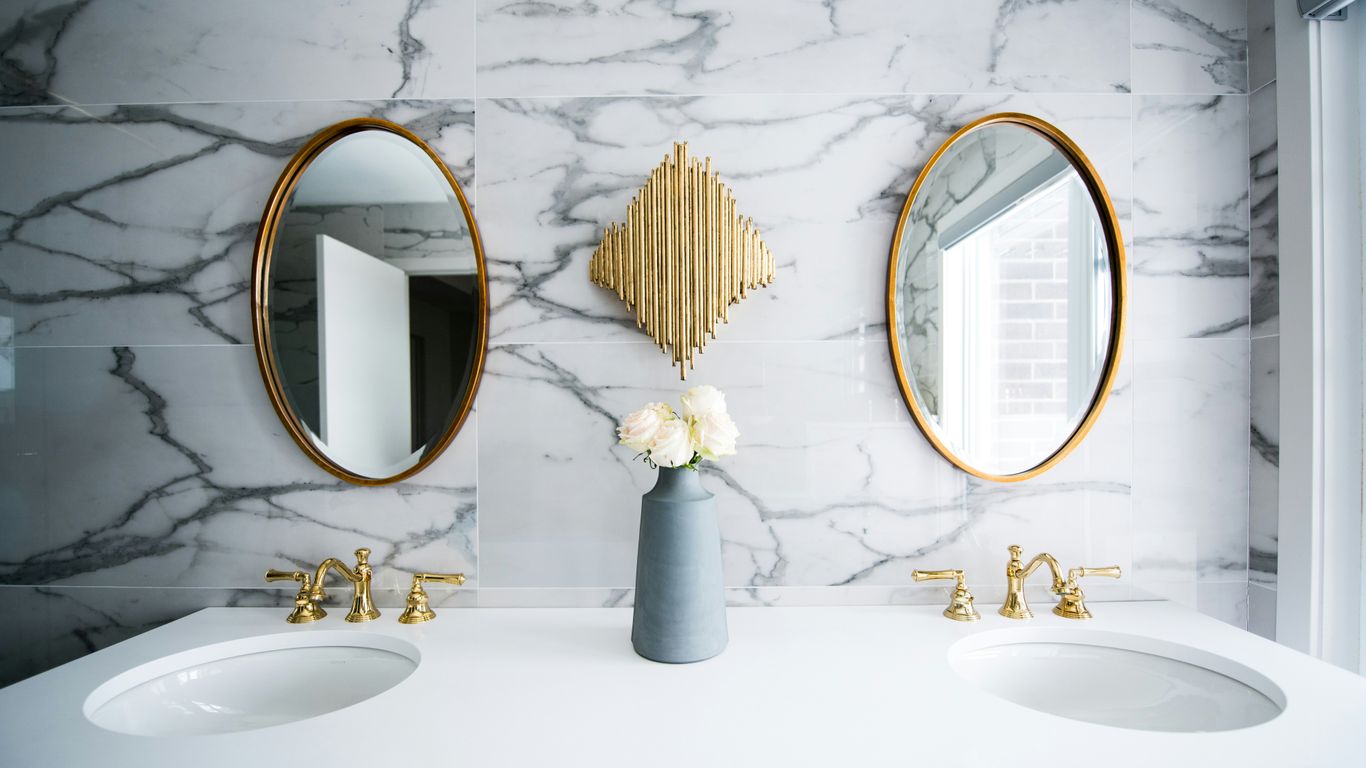
Bathrooms, vanities and shower panels
Vanities and shower panels bring veining close to the eye, making subtle tonal changes more noticeable. A basin cut-out can either interrupt a vein or frame it, depending on the setting-out. Guidance on custom marble basins is useful when dimensions, drainage, finish and vanity integration need to be considered as one design rather than as separate decisions.
For a made-to-order piece, Geoscenic Stone describes a process in which dimensions, stone, finish and edge profile are confirmed for the individual project, with a detailed drawing provided for approval before production. That approach is particularly helpful when a vein must sit in a specific relationship to a basin, wall or furniture base.
Planning joins, bookmatching and vein matching
A striking slab can lose its impact if joins are treated as an afterthought. Bookmatching, matching adjacent veins and positioning cut-outs all require decisions before the stone reaches the workshop. The aim is not always to make the material look manufactured; it is to make the chosen degree of continuity feel intentional.
What bookmatching achieves
Bookmatching places two slabs or panels beside one another so their mirrored faces create a symmetrical composition. It can turn broad movement into a central feature, especially on walls, fireplace surrounds and large furniture tops. Because natural slabs are not perfectly uniform, the result should be approved from actual slab images rather than assumed from a small sample.
Aligning veins across adjoining slabs
Vein matching follows the visual route of a line from one piece into the next. The match may be close and controlled or looser, allowing the stone’s natural variation to remain visible. A fabricator needs the slab sequence, finished dimensions and orientation together; changing one after approval can affect every adjoining panel.
Managing seams, corners and cut-outs
Seams are influenced by slab size, access, structural requirements and the position of fixtures. Corners may be mitred, butt-jointed or expressed, depending on the design and material thickness. Mark the locations of sinks, taps, sockets, hinges and fixings early, since moving a cut-out can change which section of the vein remains visible.
When a less symmetrical layout works better
Not every room benefits from a mirrored centreline. A less symmetrical layout can feel quieter and more natural when the stone has irregular movement or when the architecture is already busy. The vein placement guide discusses pattern matching alongside a looser approach for marbles with varied directions, which can be useful when strict symmetry would look forced.
Selecting and installing marble with confidence
Good selection is a shared process between client, designer and fabricator. It involves more than choosing a colour: dimensions, orientation, finish, edge treatment, access and the expected character of the stone all need to be recorded. For bespoke furniture and architectural pieces, an approved production drawing provides a practical reference for those decisions.
Reviewing full slabs rather than small samples
A sample can show background colour and surface feel, but it cannot show how movement travels across a two-metre wall or tabletop. Review the full slab, or clear images of it, with the intended outline placed over the material where possible. This is also the moment to identify open fissures, filled areas, tonal shifts and marks that may fall near a visible edge.
Discussing vein direction with the fabricator
Use plain, specific language: “the long vein runs with the island” is more useful than “make it flow”. Ask for the proposed slab layout, face direction, seam positions and orientation of returns. A fabricator can then explain what is achievable within the available material and where a compromise may be needed.
Allowing for colour variation and filled fissures
Filled fissures may be part of the finished appearance, and the fill can read differently from the surrounding stone under changing light. Tone, porosity, mineral marks and vein contrast can also vary within a single selection. These are inherent characteristics of natural marble, not promises that can be standardised across every piece.
Balancing appearance, practicality and maintenance
Choose the visual effect alongside the intended use, cleaning routine and tolerance for etching or marking. A honed finish may read more softly, while a polished surface reflects more light and can make contrast appear stronger; the honed and polished marble guide sets out those differences in relation to furniture and everyday use. For a project requiring careful coordination of stone, finish, edge profile and delivery, plan your commission early so the quotation can reflect the actual piece, packing and site requirements.
Before installation, confirm dimensions, access, support and the final setting-out. Once the stone is fixed, small changes to orientation or seam position are usually no longer practical.
Conclusion
Marble veining becomes most effective when it is treated as part of the design from the first slab review to the final installation. Direction, cutting method, joins and natural variation all influence the finished piece, so careful planning allows the stone to look intentional without losing its geological character.
Frequently Asked Questions
Is marble veining the same throughout a slab?
No. Veins can change in width, contrast, direction and density across the slab, which is why a full-slab review is more reliable than a small sample.
Does vein direction change the colour of marble?
The underlying minerals do not change, but cutting direction and reflected light can make colours and contrast appear different from one face or orientation to another.
What is the difference between vein-cut and cross-cut marble?
Vein-cut marble commonly reveals longer, more linear bands, while cross-cut marble often shows cloudier, swirling or broader movement.
Is bookmatching always the best choice?
No. Bookmatching creates symmetry, but a looser arrangement may suit irregular movement, busy architecture or a design that aims to feel more natural.
How should seams be planned in veined marble?
Plan seams with the slab layout, cut-outs, corners, access and strongest veins together. The best position depends on the specific material and the finished dimensions.
Can a small sample represent a complete marble slab?
It can indicate the general background and finish, but it cannot represent every vein, fissure, tonal shift or change in movement across a full slab.
Does marble require maintenance after installation?
Yes. Maintenance depends on the marble, finish and use, but gentle cleaning, suitable sealing where specified and prompt attention to spills are sensible general measures.