
Key Takeaways
Marble bookmatching is a design technique that makes the natural movement of stone the centre of attention. The most successful results come from treating slab selection, layout and installation as one connected process.
- Bookmatching places adjacent slabs so their veining forms a mirrored, open-book pattern.
- The direction, scale and contrast of the veining determine how dramatic the finished surface feels.
- Full-slab review and a drawn layout are essential before cutting or fabrication begins.
- Bookmatched marble suits feature areas, but it can involve more waste, handling and fabrication cost.
- Careful sealing, gentle cleaning and prompt repairs help preserve the surface over time.
What marble bookmatching means
Marble bookmatching is the arrangement of two neighbouring slabs to create a reflected pattern across a central join. It is particularly effective when the stone has visible movement, because the veining becomes part of the architecture rather than a background detail. The effect can be quiet and finely balanced or highly graphic, depending on the material selected.

How adjacent slabs create a mirrored pattern
The slabs are normally taken from the same block and opened beside one another, like the pages of a book. Their adjoining edges form the centre line, while the natural veins appear to travel outwards in reflection. This is why the cut, orientation and numbering of each slab matter so much; a small change in order can alter the entire composition.
The finished result is not necessarily perfectly geometric. Mineral deposits, shifts in colour and changes in vein density remain visible, giving the surface a natural character. The technique is explained well in this overview of bookmatched marble processing, which also shows why preparation and handling require care.
Bookmatching versus vein matching and slip matching
Bookmatching aims for a mirrored relationship between slabs. Vein matching is a broader term for aligning visible movement across a join, while slip matching places slabs in the same orientation so the pattern continues in one direction rather than reflecting. These approaches can look quite different, even when they use the same marble.
The right method depends on the intended visual rhythm. A fireplace may benefit from a strong central mirror, whereas a long wall or worktop might look calmer when the veining runs consistently from one end to the other.
How the direction of the veining affects the final design
Veins can rise, sweep sideways, break into clouds or gather around a particular area of the slab. Rotating the material changes the energy of the design: vertical movement can heighten a wall, while broad horizontal lines may make a surface feel wider. The centre line should therefore be decided with the room, not just the slab, in mind.
A useful reference is this guide to marble vein direction, particularly when deciding how cutting and orientation will affect visual continuity. Vein direction shapes proportion as much as colour does, so it deserves attention at the earliest design stage.
Why natural variation makes every bookmatched installation unique
Bookmatching creates visual correspondence, not industrial uniformity. The two slabs may share a geological origin yet still differ subtly in tone, pore structure, mineral marks and the strength of individual veins. Those differences are part of the appeal, but they should be viewed in the full slabs before approval.
A well-considered design leaves room for this variation instead of promising an identical pattern. The goal is a convincing relationship between the pieces, with the natural character of the stone still apparent.
How to choose marble for a bookmatched design
Choosing marble for a mirrored layout involves more than finding two attractive slabs. The colour, vein structure, dimensions, thickness and condition must all work together, and the usable area should be assessed after necessary cuts are considered. A full-slab review is more informative than relying on a small sample or a single photograph.

Selecting slabs with compatible colour and veining
Start by viewing the slabs side by side under lighting similar to the final room. Look for a compatible base colour and a vein structure that will read as a pair once opened. Perfectly identical tone is not required, but abrupt differences can make the join feel accidental rather than deliberate.
Strongly veined marble often creates the most recognisable bookmatch, while quieter stone can produce a softer, almost abstract effect. If the slab will become furniture, consider how the pattern will meet the edges, base and any adjoining material.
Evaluating slab size, thickness and usable yield
Slab dimensions should be checked against the finished elevation, including returns, edge details, cut-outs and allowances for fabrication. Nominal size is not the same as usable yield: damaged edges, fissures or areas lost to openings may reduce what can be included in the composition.
Thickness also affects weight, edge proportions and installation planning. A drawing should show the finished dimensions rather than leaving these decisions until the cutting stage. For furniture, this guide to choosing a marble slab is a useful reminder to consider support, impact and the intended function alongside appearance.
Checking for fissures, repairs and other natural characteristics
Inspect the full slab for fissures, filled areas, colour shifts and mineral concentrations before the layout is approved. These characteristics are not automatically unacceptable, but their position matters. A repair near a sink cut-out may have different implications from one placed in an uninterrupted focal area.
The fabricator should also explain how the selected characteristics may affect cutting, reinforcement, transport and installation. Clear discussion at this stage reduces surprises later and makes the final approval more meaningful.
Matching the finish to the intended visual effect
A polished finish reflects light and can increase the apparent contrast of veining, giving the bookmatch a more formal and dramatic presence. A honed finish absorbs more light and tends to feel quieter, with a softer reading of colour and movement. Textured finishes introduce another layer of surface character and may be suited to particular architectural settings.
The choice should account for lighting, use and maintenance, not appearance alone. This comparison of honed and polished marble offers helpful context when deciding how the finish will influence both the pattern and everyday wear.
Where bookmatched marble works best
Bookmatched marble is most effective where the surface can be seen as a broad composition rather than broken into many small pieces. It can anchor a room, frame a view or give a modest architectural element unusual presence. The scale of the pattern should always be judged against the room and the amount of visual activity already present.

Feature walls and fireplace surrounds
A feature wall provides the clearest canvas for a mirrored arrangement, particularly when the centre line can remain uninterrupted. Fireplace surrounds can use the same principle to frame the opening and draw attention to the hearth. In both cases, joints, outlets and trims should be planned so they do not cut through the strongest part of the pattern without reason.
A restrained room often allows expressive marble to lead. If the surrounding finishes are already busy, a quieter stone or smaller panel may create a more comfortable balance.
Kitchen islands, splashbacks and worktops
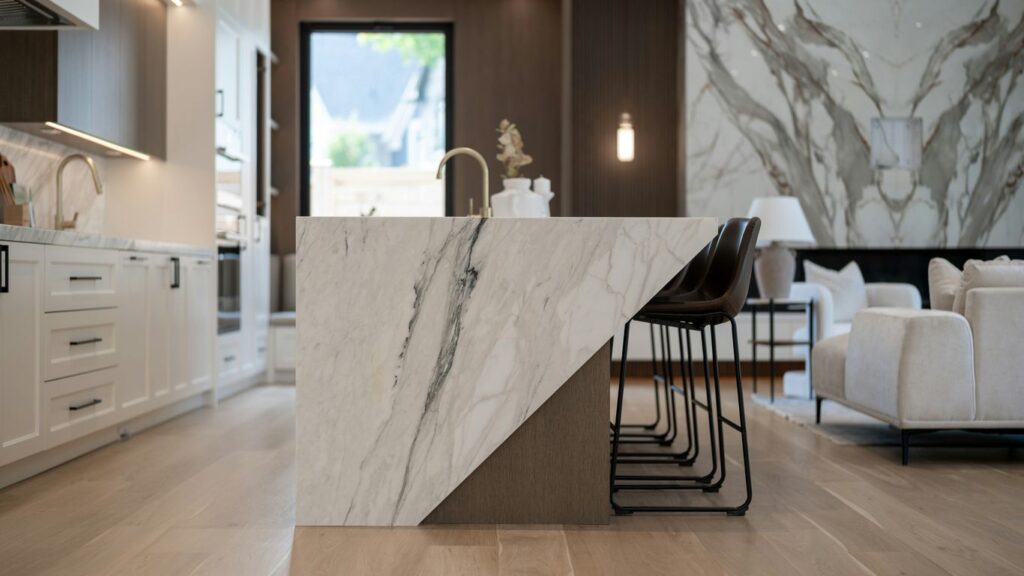
An island can display a bookmatch across its top, waterfall edges or both, although every additional face affects the layout and yield. Splashbacks are another strong application because they offer a relatively uninterrupted vertical plane behind the worktop. Worktops require more practical planning around sinks, hobs, drainer grooves and edge profiles.
The pattern should be positioned before these openings are finalised. A technically neat installation can still feel visually awkward if a tap hole or hob interrupts the focal vein at the wrong point.
Bathroom walls, shower areas and vanity units
Bathrooms often provide controlled surfaces where the open-book effect can be appreciated at close range. A pair of slabs behind a vanity or across a shower wall can make a compact room feel carefully composed without adding more decorative materials. Waterproofing, drainage, access panels and service penetrations remain just as important as the appearance.
The finish should be selected with moisture, touch and cleaning in mind. On a vanity, the edge and basin cut-out can either reinforce the symmetry or deliberately sit outside it.
Floors, staircases and commercial interiors
Floors and staircases can use bookmatching, but they demand especially careful consideration of slip resistance, wear, joins and changing viewpoints. In hotels, restaurants and retail spaces, a bookmatched wall or reception feature may deliver the effect with less exposure to heavy traffic.
Commercial interiors also have opportunities for supporting details. For example, a hospitality project may pair a stone focal point with practical elements such as custom beer coasters, keeping the marble as the architectural feature rather than asking it to carry every part of the identity. Local character can also inform a brief, much as a designer might draw on the architectural and natural setting described in this Hayesville design guide.
How to plan a bookmatched marble installation
Good bookmatching is planned before fabrication, not discovered during installation. The drawing should show the slab order, centre line, orientation, cut-outs, edge treatments and relevant dimensions. It should also make clear which decisions depend on the approved material and which remain subject to site verification.

Creating a full-size layout before fabrication
A full-size layout allows the design team to see the actual vein movement at the intended scale. Slabs can be numbered, rotated and compared before any irreversible cuts are made. This is the point to decide whether a dominant vein should sit at eye level, frame an opening or be avoided in a narrow offcut.
The layout should be reviewed by the client, designer and fabricator together. It is also a practical record of what has been approved, rather than merely an image used for inspiration.
Establishing the centre line and vein direction
The centre line gives the installation its organising principle. It may align with a fireplace, island axis, basin, doorway or another architectural feature, but it does not have to be mathematically central to the room if a different alignment produces better balance.
Once the line is fixed, the slabs should be checked for their intended direction. Reversing one piece late in the process can change the movement, edge relationships and positions of natural features.
Positioning joins, cut-outs and fixtures
Every opening removes part of the visual field, so sinks, sockets, switches, taps and ventilation grilles should appear on the working layout. Where possible, place them in calmer areas of the stone or use the symmetry to frame them. Seam positions should be reviewed in the same way, especially on islands and long walls.
A concise fabrication checklist can include:
- slab numbers and the direction each piece faces;
- finished dimensions, edge profiles and visible returns;
- cut-outs, drillings, joins and service penetrations;
- acceptable natural characteristics and areas to avoid;
- access, lifting and installation notes for the site.
This list is most useful when it is translated into a drawing that everyone can approve. It should guide production without pretending that natural stone can be controlled like a printed surface.
Coordinating the design with lighting and room proportions
Light changes how marble reads throughout the day. Raking light can emphasise relief and filled fissures, while diffuse light may soften the difference between neighbouring slabs. Review the layout under the room’s likely lighting, including wall washers, pendant lights and daylight from nearby windows.
Proportion matters too. A large, high-contrast bookmatch may dominate a small room, while delicate movement can disappear on a broad wall. The best result gives the stone enough space to be seen without making every surrounding element compete with it.
Allowing for slab handling, access and installation requirements
Large slabs need a realistic route from delivery point to their final position. Door widths, lift dimensions, stair turns, floor loading, protection and lifting equipment may all affect what can be made and how it can be installed. The site team should confirm these conditions before fabrication is complete.
Geoscenic Stone operates on a factory-to-order basis: pieces are cut, formed, finished, inspected and packed for a specific project, with dimensions, stone, finish, edges and drillings confirmed in an approved production drawing. That approach makes project-specific coordination central to the process, rather than treating the finished piece as interchangeable stock.
The benefits and limitations of bookmatched marble
The appeal of bookmatching is immediate, but the decision should include its practical demands. More stone may be required to preserve the composition, and fabrication can involve additional layout, polishing, handling and installation work. The result can be highly distinctive, provided the design brief allows for those implications.
Why mirrored veining creates a strong focal point
A mirrored pattern gives the eye a clear point of order. It can turn a wall, island or fireplace into the element that establishes the mood of the room, especially when the marble has strong colour contrast or sweeping movement. The symmetry feels intentional without removing the irregularity that makes natural stone interesting.
This is why bookmatching is often used selectively rather than across every surface. A single well-positioned feature can carry more visual weight than a room covered in competing patterns.
How bookmatching can make a space feel more balanced
Reflection introduces a sense of equilibrium around a centre line. In a room with asymmetrical furniture or architectural openings, that quality can provide a visual anchor. It can also help relate two sides of an elevation, making the composition feel calmer even when the marble itself is expressive.
Balance does not mean perfect sameness. Slight changes in tone and vein density keep the material from appearing synthetic, while the repeated direction gives the eye a coherent path through the space.
The impact of material waste and higher fabrication costs
Bookmatching may require slabs from the same block, careful sequencing and cuts that prioritise the pattern over maximum yield. Offcuts can be difficult to reuse if their colour or veining no longer suits the design. More involved handling and seam planning may also affect the quotation.
Geoscenic Stone’s quotations account for the individual piece, weight, packing, destination, site access and any installation requirements. For a bookmatched commission, those project-specific factors should be discussed alongside the stone and dimensions rather than reduced to a simple area price.
When bold veining may overwhelm the rest of the interior
Very active marble can compete with cabinetry, flooring, artwork and lighting. If several surfaces have strong patterns, the mirrored effect may make the room feel crowded rather than composed. A quieter surrounding palette, simpler silhouettes and controlled lighting usually give expressive stone more room to work.
It is also worth considering sightlines from adjoining spaces. A pattern that feels measured from one position may become dominant when seen from a hallway or open-plan living area.
Situations where porcelain or engineered alternatives may be more practical
An alternative material may be worth considering where consistent repetition, lower porosity, reduced weight or a particular maintenance routine is more important than natural variation. The choice depends on use, scale, budget, site conditions and the character the project needs.
Natural marble remains compelling when the geological variation is part of the brief. It is less suitable when the client requires a perfectly repeatable image or when access and handling make large stone elements impractical. Geoscenic Stone makes made-to-order furniture and architectural pieces in travertine, marble and onyx, so the material decision can be considered alongside the specific form and project requirements.
Caring for and maintaining bookmatched marble
Bookmatched marble needs the same thoughtful care as other natural marble, with added attention to the visible join and the continuity of the finish. Sealing can reduce the risk of staining, but it does not make the surface immune to acids, abrasion or standing moisture. Maintenance should be matched to the stone type, finish and use rather than treated as a one-size-fits-all routine.
Choosing the right sealant for the marble type and application
The appropriate sealant depends on porosity, finish, location and expected use. A kitchen worktop, shower wall and decorative fireplace surround may have very different requirements. The selected product should be tested discreetly and applied according to the manufacturer’s instructions, with particular care around edges and cut-outs.
Sealing also does not replace prompt cleaning or sensible use. It is one part of a wider care plan, and the interval between applications should be reviewed according to performance rather than assumed from a fixed calendar.
Preventing staining, etching and damage from everyday use
Wipe spills promptly, especially acidic liquids and strongly coloured foods. Use trivets under hot objects, avoid dragging abrasive items across the surface and keep gritty debris away from frequently used areas. Bathrooms benefit from good ventilation and drying, while kitchens need attention to the areas around sinks and dispensers.
Natural marble can show etching even when it has been sealed. Understanding that distinction helps set realistic expectations and makes it easier to decide when professional refinishing is appropriate.
Cleaning the surface without affecting the finish
Use a soft cloth or non-abrasive pad with a suitable pH-neutral cleaner, then remove residue and dry the surface. Avoid vinegar, bleach, acidic descalers and harsh scouring powders, which can affect the stone or finish. This advice on cleaning marble safely is especially useful for establishing a simple daily routine.
The cleaner should be compatible with the specific finish. A polished surface, a honed surface and a textured surface may respond differently to repeated wiping, so a small test area is sensible before wider use.
Repairing chips, scratches and visible seam issues
Small chips, scratches and seam concerns should be assessed rather than concealed with household products. A stone specialist can determine whether the issue is a surface mark, local impact, movement at the join or a finish inconsistency. Repairs may involve filling, honing, polishing or carefully reworking a local area.
The earlier a problem is examined, the easier it may be to preserve the surrounding pattern. Keep the approved layout and material information available so any repair can be judged against the original design intent.
Discuss Your Stone Project
If you are considering a bookmatched wall, worktop or made-to-order piece, request a quotation with the intended dimensions, application, finish and site details so the project can be assessed on its actual requirements.
Conclusion
Bookmatched marble works best when its visual drama is supported by disciplined planning: review the full slabs, establish the centre line, draw every cut-out and allow honestly for handling, yield and maintenance. Its natural variation is not a flaw to disguise but a quality to understand, making each installation individual while still giving the room a clear architectural rhythm.
Frequently Asked Questions
Is bookmatched marble made from two separate slabs?
Usually, the slabs are taken from the same block and opened beside one another so the veining forms a mirrored relationship. Their colour and movement may still vary naturally.
Does bookmatching create a perfectly symmetrical pattern?
It creates a mirrored arrangement, but natural stone is not perfectly uniform. Differences in tone, mineral marks, fissures and vein density can remain visible across the join.
Which marble has the best veining for bookmatching?
Marble with clear directional movement, strong veins or layered colour often produces the most obvious effect. Quieter stone can also work when a more restrained composition is preferred.
Is bookmatched marble more expensive than a standard slab layout?
It can be, because it may require compatible slabs, more careful sequencing, additional fabrication and greater material waste. The final cost depends on the design, dimensions, stone, site and installation requirements.
Can bookmatched marble be used in a kitchen?
Yes, it can be used for islands, splashbacks and worktops, provided that cut-outs, sealing, edge details and everyday care are planned appropriately.
Is honed or polished marble better for a bookmatched feature?
Neither finish is universally better. Polished marble generally reflects more light and intensifies contrast, while honed marble gives a softer, more subdued appearance; the choice should suit the room and its use.
How should a bookmatched marble surface be cleaned?
Use a soft cloth and a suitable pH-neutral cleaner, remove residue and dry the surface. Avoid acidic products, bleach, abrasive powders and prolonged contact with spills.