
Key Takeaways
The better table shape is the one that fits your room, your routines and the way you host. Round and rectangular tables can both work beautifully when their dimensions and circulation space are considered together.
- Round tables soften compact or square rooms and make conversation feel inclusive.
- Rectangular tables use long rooms efficiently and usually offer more defined seating.
- Clearance around chairs matters as much as the tabletop dimensions.
- An oval or extendable design can bridge the differences between the two shapes.
- Natural stone tables should be specified around the room, access route and intended use.
How each table shape uses floor space
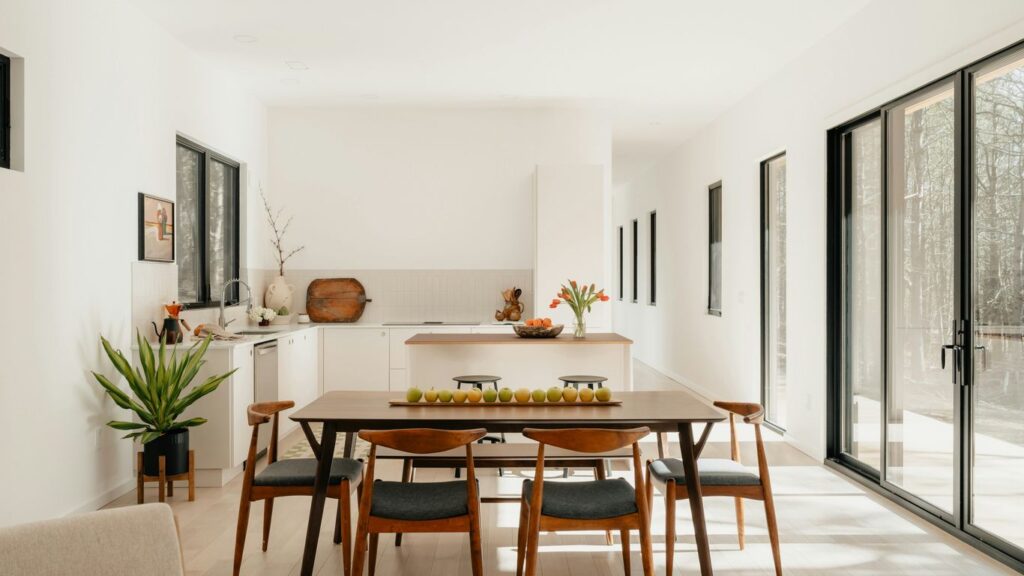
The outline of a dining table affects more than its appearance. It changes the gaps left for chairs, the routes people take through the room and the way the dining area relates to nearby furniture. Before choosing between a round vs rectangular dining table, mark the available footprint on the floor and observe how the room actually works.
When a round table makes a compact room feel more open
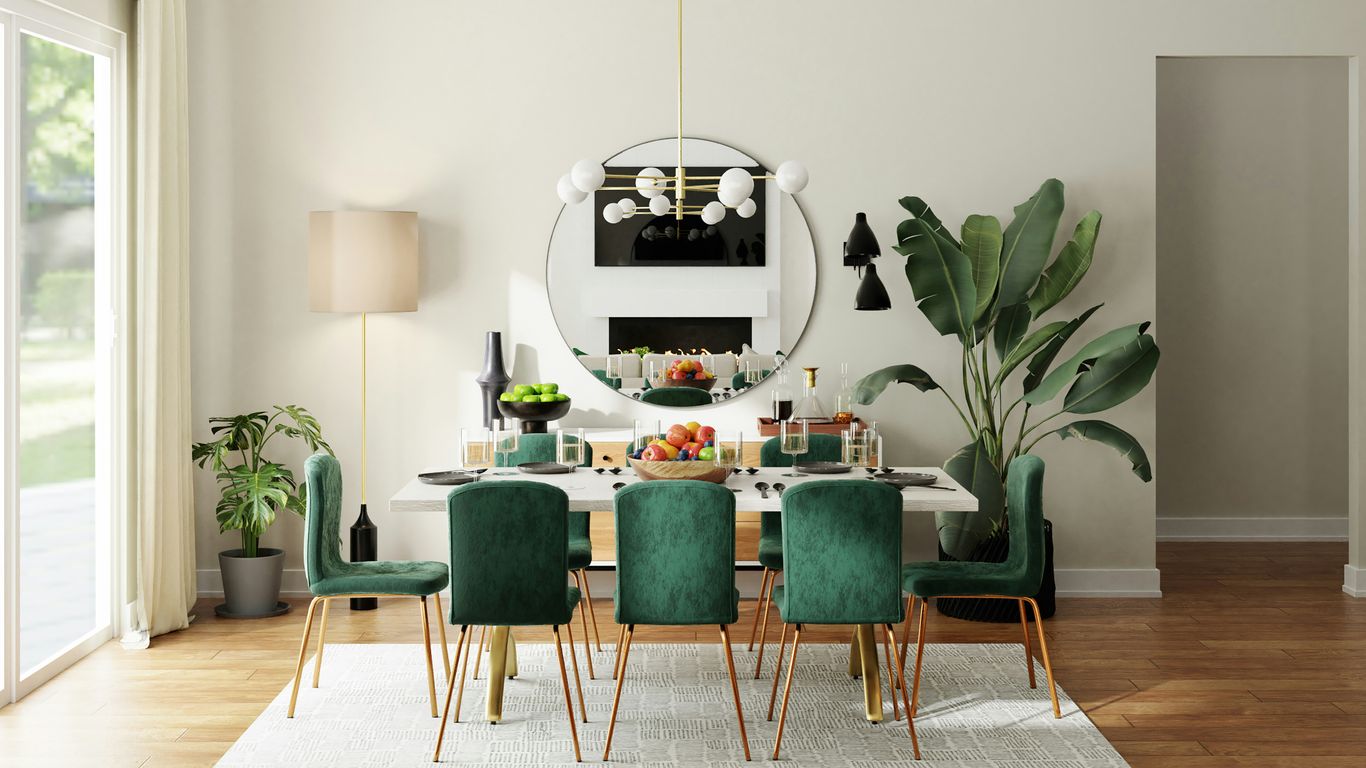
A round tabletop removes corners from the routes around it, which can make a small room feel less interrupted. It is especially comfortable in a square dining area, where a circular form can sit centrally without competing with the room’s geometry. The effect is not magic—the table still needs sufficient clearance—but the continuous edge often looks and feels gentler.
A pedestal base can make the footprint easier to use because diners are not negotiating with four corner legs. For a smaller stone table, the guidance on a small round marble dining table is a useful companion when checking diameter, chair movement and access.
Why rectangular tables suit long or narrow rooms
Rectangular tables naturally follow the length of a narrow room. Their straight sides can align with a wall, window or run of cabinetry, leaving a clearer passage along the remaining side. They also make good use of linear space, particularly when the room needs to accommodate six or more diners.
The risk is choosing a length that overwhelms the room. A table can fit on paper while leaving too little space for a chair to pull out, so the furniture around it must be measured as part of the same plan.
Comparing clearance around the table
Clearance is the usable breathing space between the table edge and the nearest obstruction. Allow more if chairs need to be pulled back fully or if people regularly walk behind seated diners. A round table requires clearance in every direction, while a rectangular table may allow a tighter relationship on one side if that edge sits beside a wall and is not used as a passage.
Think in terms of movement rather than an ideal diagram. Open doors, drawers, serving trolleys and the direction in which people approach their seats all affect whether the room feels comfortable.
Working with open-plan layouts and awkward corners
In an open-plan kitchen or living area, the table often defines a zone without a wall around it. A round table can create a softer island between functions, while a rectangular one can echo kitchen cabinetry and establish a clear dining axis. Awkward corners should be tested with tape or cardboard rather than judged only from a plan.
A useful external comparison of round and rectangular table layouts can help clarify the basic trade-off, but your own routes and furniture dimensions should make the final decision.
Seating capacity and everyday comfort
Seating capacity is not simply the number of chairs that can be pushed towards a tabletop. Diners need elbow room, space for plates and an easy way to sit down without disturbing someone already seated. The right choice depends on whether meals are usually intimate, family-sized or designed around frequent entertaining.

How many people each shape can accommodate
Round tables work particularly well for two to six diners because everyone remains within a similar conversational distance. As the diameter increases, reaching shared dishes becomes less convenient and the social advantage can diminish. Rectangular tables generally scale more predictably, with places added along the long sides and, when appropriate, at the ends.
For six diners, both shapes can be comfortable when correctly sized. A six-seater dining table size guide is helpful for comparing common lengths and diameters with the clearance needed around them.
Why round tables make conversation easier
At a round table, there is no formal head position and faces are naturally turned towards the centre. That arrangement suits relaxed meals, card games and gatherings where everyone is expected to take part in one conversation. It can also make a small group feel more connected without requiring anyone to lean across a corner.
The advantage depends on scale. If the tabletop becomes very large, diners may still see one another, but passing food and hearing quieter speakers become less effortless.
When rectangular tables provide more personal space
A rectangular table gives each diner a clearer section of the edge, which can feel more orderly during a long meal. There is room to place serving dishes between groups without putting every plate in the centre of the conversation. This shape is often preferable when people use laptops, spread out paperwork or need a more defined place setting.
The ends can be useful for occasional guests, though those seats may have a different relationship to the table legs. Base design and leg position should therefore be checked before assuming that every place is equally comfortable.
Allowing room for chairs, serving dishes and movement
A generous tabletop does not compensate for cramped seating. Allow room for chair backs, the arc of a person standing up and the route used to carry food from the kitchen. These four checks are a sensible starting point before choosing a final size:
- Measure the table footprint with chairs pulled out.
- Mark the main walking route from kitchen to dining area.
- Allow space for serving dishes without crowding place settings.
- Check that doors, drawers and sideboards can still open fully.
These checks often change the preferred shape. A slightly smaller round table may be kinder to movement, while a narrower rectangular table may preserve the capacity needed for a family meal.
Comparing circulation and access
Circulation is where design decisions become noticeable every day. A table may look balanced when viewed from above but cause repeated collisions if it sits across a doorway or interrupts the route between kitchen and sitting room. Consider the people who use the space most often, not only the maximum number of guests.
Creating comfortable walkways around a round table
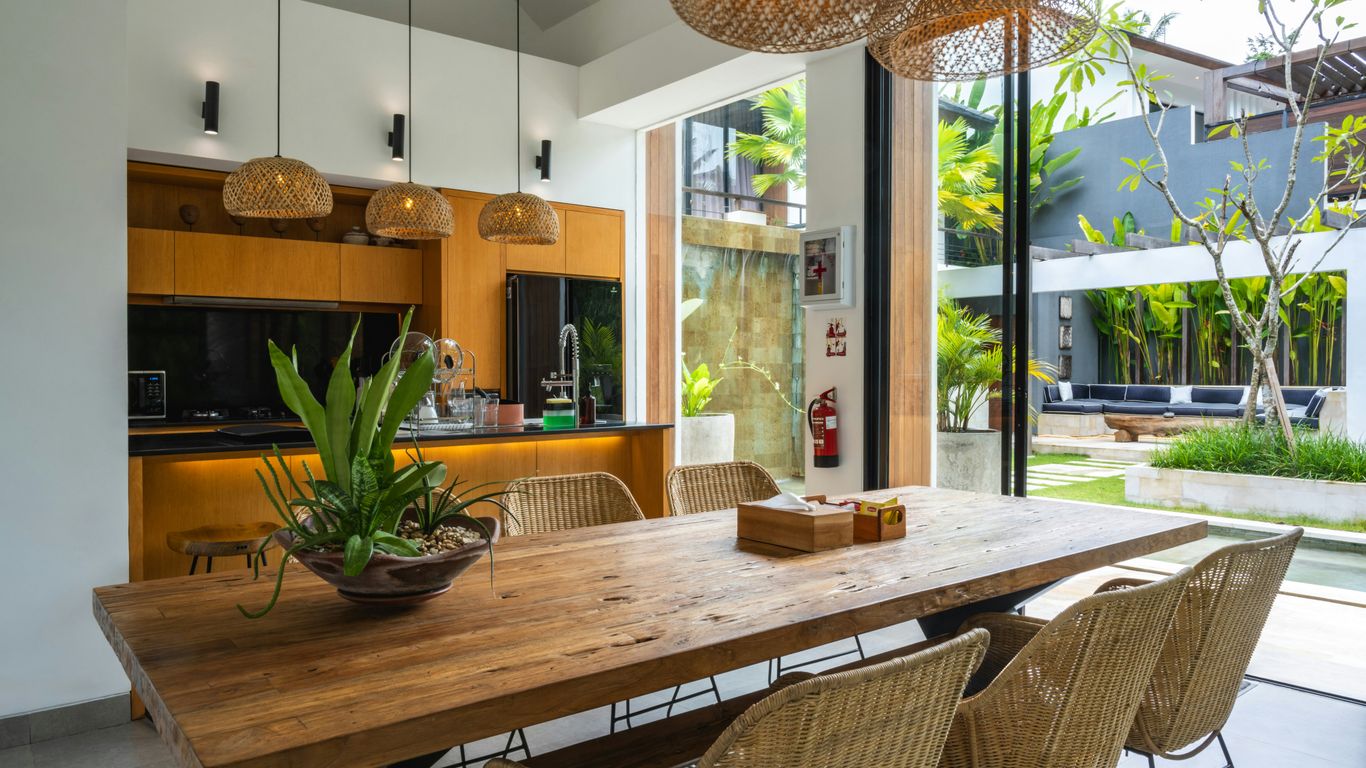
A round table encourages movement around its perimeter because there are no corners to catch a hip or chair. That can be helpful in a compact room with more than one approach route. It still needs a consistent band of clearance, especially where chairs are occupied.
The base matters as well. A central pedestal can leave more freedom for feet and chairs, whereas multiple legs may create local pinch points. Draw the base into the floor plan rather than measuring only the top.
Positioning a rectangular table without blocking routes
Rectangular tables are easiest to position when their long axis follows the principal direction of the room. Keep the end seats away from door swings and avoid placing a corner where people naturally turn. If one side must sit near a wall, treat it as a less frequently used seating edge rather than promising full access on all sides.
An extending model needs its largest footprint considered from the beginning. The closed size may fit comfortably while the extended arrangement blocks a route or approaches a piece of furniture too closely.
Managing doorways, sideboards and kitchen access
Mark every fixed and moving element: doors, drawers, refrigerator doors, sideboards and serving routes. A dining table should not force people to walk sideways when carrying hot dishes, nor should a chair block a doorway whenever the table is occupied. In open-plan spaces, even a modest shift can improve the relationship between dining and cooking zones.
This is also the point to check delivery access. A substantial stone top may pass through the room differently from a smaller assembled table, so the entrance, lift, stairs and final turning points belong in the specification.
Choosing a shape for flexible seating arrangements
Flexibility can mean adding a guest, moving the table for a party or clearing the area for another use. Rectangular tables are often easier to push against a wall temporarily, while round tables can be repositioned without worrying about which end faces the room. Oval forms offer a useful middle ground where a softer edge is wanted but a longer seating line is still necessary.
Use the arrangement you will repeat most often as the default. A table that is excellent only when fully extended may be less useful than one that feels right on an ordinary weekday.
Matching the table to your room and furniture
A dining table should belong to the room rather than appear as an isolated object. Shape, height, edge detail, material and base all influence how much visual weight it carries. This is particularly clear with natural stone, where the slab’s tone and veining are part of the composition rather than a perfectly uniform surface.
Pairing a round table with square or irregular rooms
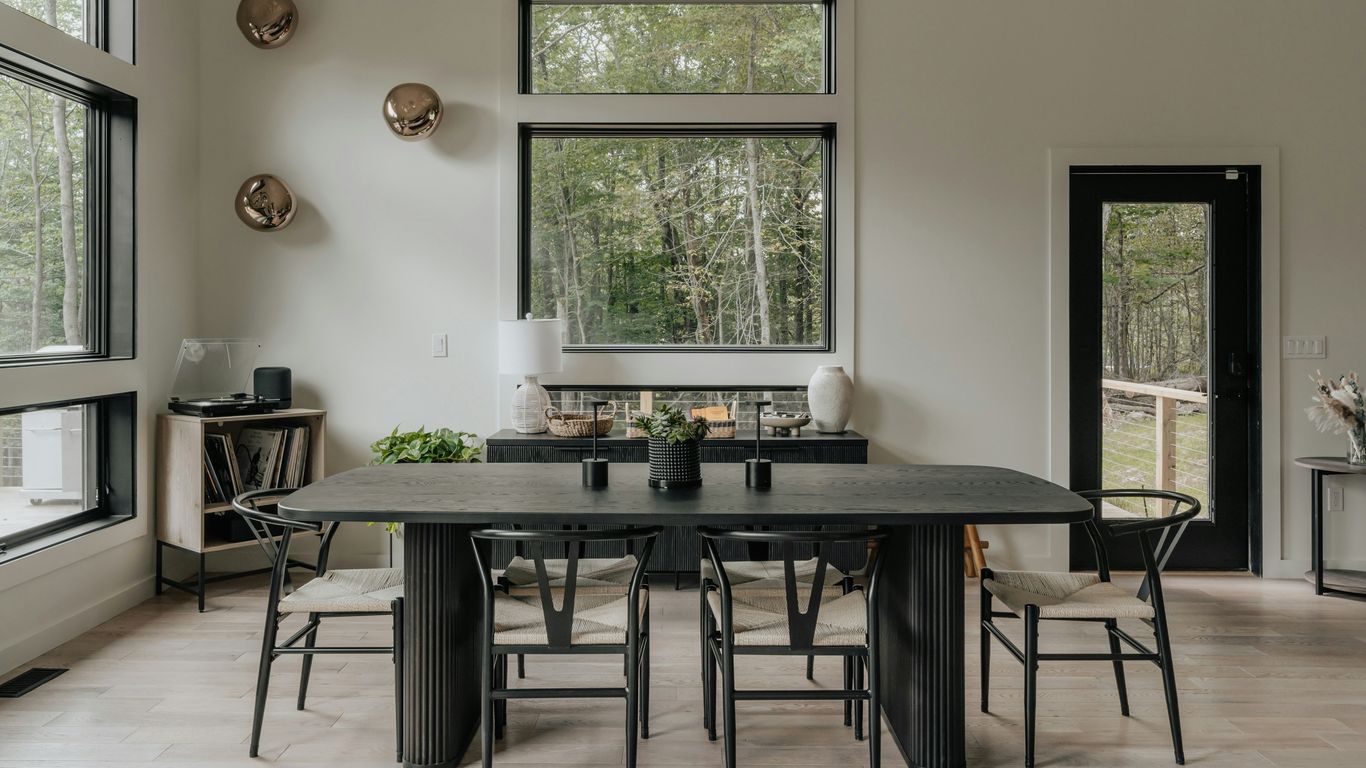
A round table can soften a square room without fighting its symmetry. It is also useful in irregular spaces because the absence of corners makes small adjustments less visually awkward. Centre it where possible, but do not sacrifice circulation merely to achieve geometric perfection.
Lighting can reinforce the arrangement. A pendant centred over the tabletop helps the round form read as intentional, while a nearby rug can define the dining zone without adding another hard edge.
Using a rectangular table in a formal dining area
A rectangular table gives a formal room a strong architectural line. It can align with a fireplace, a long window or a central pendant, and it provides a natural framework for place settings during larger meals. In a room with generous proportions, its length can feel calm rather than imposing.
Scale remains essential. A dark or heavily veined stone top may appear visually larger than its measured footprint, so leave enough surrounding space for the room to retain some quietness.
Coordinating the table with chairs, benches and lighting
Chair width, armrests and upholstery thickness all affect practical capacity. Benches can make a rectangular table more flexible along one side, but they need enough room to move out and should not be treated as a way to avoid all clearance requirements. A round table often pairs naturally with a central light, while a rectangular table may suit a linear fitting or several pendants.
For a broader overview of proportion, material and base choices, this marble dining table design guide offers useful considerations before a drawing is approved. It is sensible to coordinate the chairs and lighting at the same time as the tabletop, not after fabrication.
Balancing visual weight in small and large spaces
In a small room, a substantial stone top can dominate even when the dimensions are technically suitable. A lighter base, open leg profile or softer edge may help the table sit more comfortably in the composition. In a large room, a small table can look lost and make the surrounding furniture feel disconnected.
Material selection should reflect that balance. Geoscenic Stone makes made-to-order furniture in travertine, marble and onyx, with each piece produced to an approved drawing and material selected for the individual order. Natural variation in veining, tone, figuring and mineral marks is part of the character of the finished stone.
Practical differences in daily use
The best table is the one that remains pleasant after the photographs are forgotten. Cleaning, serving, homework, children’s meals and occasional celebrations all put different demands on the surface and the surrounding layout. Consider those ordinary moments alongside the visual impression you want.
Cleaning, serving and reaching across the tabletop
A round table keeps shared dishes within a broadly similar reach, provided its diameter is moderate. A rectangular table gives more room for platters in a central line but can make food at the far end less accessible. In either case, avoid filling the centre so completely that diners must stretch or stand repeatedly.
Surface choice also affects maintenance. Marble has natural variation and may require more attentive care than a material selected for a more consistent everyday response. The finish, sealing requirements and intended use should be discussed before production rather than assumed from a photograph.
Using round tables safely in family homes
The lack of corners can reduce one obvious bump point in a busy household, although it does not remove every safety concern. Stable construction, an appropriate base and enough space to walk around the chairs still matter. Keep hot dishes away from the edge and consider how children approach the table from the kitchen or living area.
A pedestal can improve legroom, but its footprint must remain stable and clear of feet. Safety is therefore a combination of shape, construction, placement and daily habits.
Accommodating children, guests and larger gatherings
Families often need a table to work for quick breakfasts as well as long weekend meals. Rectangular tables can provide extra places at the ends, while round tables keep a smaller group socially connected. For occasional larger gatherings, an extension may be more useful than choosing a permanently oversized top.
Guest comfort is also about movement. A seat that technically fits but cannot be pulled out without striking a wall will not feel like a real place at the table.
Considering extendable designs and occasional seating
An extendable table should be assessed in both states, including the position of chairs, lighting and nearby furniture. Check how the leaves are stored, how the joint is supported and whether the extended surface remains visually coherent. An oval extension can preserve softer corners while adding useful length.
For hospitality settings, a further consideration is how guests move around the table between courses. QR signage may sometimes support service information, and a guide to restaurant QR code stickers explains how table, counter and packaging placements can connect visitors with digital menus or other options. The table itself, however, should remain easy to approach and clear to serve.
Choosing the right table dimensions
Dimensions should be selected from the room outward, not from a preferred catalogue size inward. Start with the number of everyday diners, add the space needed for chairs and movement, then test the largest arrangement you genuinely expect to use. The final specification should include the top, base, edge and any extension mechanism.
Recommended diameter for two, four and six diners
For two diners, a compact round table can be intimate without taking over the room. Four diners usually need a larger diameter that allows place settings and shared dishes, while six diners require enough central reach as well as perimeter space. Exact comfort varies with chair width, table height, base design and how formally the table is set.
As a broad planning exercise, test diameters around 75–80 cm for two, 100–110 cm for four and 130–150 cm for six, then verify the result with real chairs. These are starting points rather than universal rules, and a round marble dining table guide gives further context on sizing and circulation.
Suitable length and width for rectangular tables
A rectangular table needs enough length for each place setting and enough width for plates, serving dishes and comfortable arm positions. A narrower top can work in a tight room, but it may reduce the space available for shared food. A longer table is useful for capacity, though it should not force end seats into doorways or corners.
For six diners, a length around 150–180 cm is often a useful starting range, with the width chosen according to the room and serving style. Confirm the actual chair dimensions and leg positions before treating those figures as final.
Calculating table-to-wall and table-to-chair clearance
Measure from the table edge to the nearest wall or furniture, then repeat the measurement with the chair pulled out to its normal sitting position. Around 90 cm is a practical target for a comfortable route in many dining layouts, though a wider passage may be needed where people walk behind seated diners. Tightening one edge may be acceptable if it is deliberately treated as a non-access side.
Record door swings and drawer fronts on the same plan. A clearance number is useful only when it describes the movement the room actually requires.
Checking proportions against the room’s dimensions
A table should leave enough negative space for the room to breathe. Compare its length or diameter with the room’s clear dimensions, then look at it alongside rugs, sideboards, pendant lights and the visual mass of the base. A large stone top can be specified precisely yet still feel too dominant if the surrounding furniture is delicate.
Keep a written schedule of dimensions, finishes, access notes and tolerances. The same reporting habit used to connect activity with outcomes in SEO reporting is useful here in a simpler form: make each decision traceable to a practical requirement rather than relying on impressions alone.
Round vs rectangular dining table: Which should you choose?
There is no universal winner in the round vs rectangular dining table question. The right answer comes from the relationship between your room, your household and the way meals are served. Shape is only one part of the decision, alongside dimensions, base, material, finish, access and future flexibility.
Choose round for sociable dining and better flow
Choose round when conversation is central, the room is compact or square, and a softer route around the table would be useful. It suits smaller groups particularly well and can make a dining area feel less formal. Check the diameter carefully so that the social benefit is not lost through excessive distance between diners.
Choose rectangular for capacity and defined seating
Choose rectangular when the room is long, when you need more capacity or when a clear seating arrangement suits the way you entertain. Its straight edges can align with architecture and make serving zones easier to organise. Make sure the length does not consume the circulation space that made the room practical in the first place.
When an oval or extendable table may work better
An oval table can combine a longer seating line with softened ends, making it a strong option for rooms where a rectangle feels too severe. An extendable design is useful when everyday meals involve fewer people than occasional gatherings. It should still look balanced when closed and remain comfortable when open.
Commissioning made-to-order furniture can help when standard proportions leave awkward remnants of space. Geoscenic Stone confirms dimensions, stone, finish, edges and drillings in an approved production drawing before the piece is produced, with packing and delivery considered for the individual destination.
A practical checklist for making the final decision
Before committing, walk through the room with the proposed footprint and ask how it will behave on an ordinary day. Write down the answers rather than relying on a showroom impression:
- Which shape leaves the clearest route from the kitchen?
- How many people need comfortable places every day?
- Will chairs, benches and armrests fit without crowding?
- Does the closed and extended footprint both work?
- Can the finished piece enter the building and reach its final position?
That checklist turns an aesthetic preference into a workable brief. If the decision involves a made-to-measure stone piece, request a quotation with the room dimensions, preferred shape, seating needs, access information and finish requirements so the proposal can reflect the actual project.
Commission a Considered Table
If you are planning a made-to-order stone dining table, Geoscenic Stone can discuss the room, dimensions, material and delivery requirements before preparing a project-specific quotation. Share a measured plan and your preferred shape to begin a practical conversation.
Conclusion
Round tables tend to bring softness, flow and easy conversation to compact or sociable settings, while rectangular tables make strong use of long rooms and offer dependable capacity. The most successful choice is the one tested against chairs, routes, doors, serving habits and the character of the material, with every dimension confirmed before production.
Frequently Asked Questions
Is a round dining table better for a small room?
Often, yes. Its lack of corners can make movement feel smoother and reduce visual interruption, but the diameter and clearance around pulled-out chairs still determine whether it fits comfortably.
What shape is best for a long narrow dining room?
A rectangular table usually follows the room’s length efficiently and can leave a clearer passage along one side. Measure doorways, furniture and chair movement before selecting the final length.
Does a round table seat more people than a rectangular table?
Usually not once the table becomes large. Round tables are comfortable for small and medium groups, while rectangular tables generally add places more efficiently along their long sides and ends.
How much space should be left around a dining table?
Around 90 cm is a useful planning target for many routes, measured from the table edge to nearby furniture or walls. More space may be needed where people walk behind occupied chairs or where doors open nearby.
Are rectangular tables more practical for entertaining?
They can be, particularly when you need extra capacity, defined place settings or an extendable surface. Their practicality depends on whether the larger footprint still allows people to move and serve comfortably.
Is an oval table a good compromise?
An oval table can offer the length and capacity of a rectangle with softer ends. It is worth considering when you want flexible seating but have concerns about sharp corners or a visually rigid outline.
Should the table shape be chosen before the material?
Shape and material should be considered together. The weight, visual presence, finish and maintenance needs of the chosen material can change how large or substantial the table feels in the room.